Selling your current car and buying another one can feel like two separate jobs.
First, you need to figure out what your existing vehicle is worth.
Then you need to find a buyer.
After that, there may be inquiries, negotiations, inspections, paperwork, payment arrangements, and ownership-transfer requirements.
Only once all of that is complete can you properly focus on your next vehicle.
A trade-in can simplify the process by connecting the sale of your current vehicle with the purchase of another one.
Instead of selling your car privately and then using the money to buy another vehicle, you can have your existing car assessed by a dealer and, if accepted, use its agreed value toward another vehicle.
First Choice Cars currently describes its trade-in service as a process in which the value of an eligible existing vehicle can be applied toward another vehicle from its inventory. The company offers an online starting point, inspection, valuation, and trade-in process.
- But how does the process actually work?
- What happens if your current car still has a loan?
- What determines the trade-in value?
- And when does trading in make more sense than selling privately?
Let's break down the complete process.
What Does Trading In a Car Actually Mean?
A trade-in, also called a part exchange, means that your current vehicle becomes part of the transaction when you purchase another vehicle.
Instead of selling the old car separately and then paying the full amount for the replacement vehicle, the agreed value of your existing vehicle can be credited toward the replacement.
For example, suppose you want to purchase another used car.
Your existing vehicle is inspected and receives an agreed trade-in value.
That value is then taken into account when calculating the amount required for the replacement vehicle.
The exact figures depend on the vehicles, the agreed prices, finance arrangements, and transaction terms.
The important difference is that you are connecting the two transactions.
First Choice Cars' current car trade-in page explains that customers provide their vehicle information, arrange an inspection, receive an offer, and can then complete the trade-in toward another vehicle from the company's inventory.
Trade-In vs. Selling Your Car Outright
Before choosing a trade-in, it helps to understand what you are actually comparing.
Selling Privately
With a private sale, you are responsible for finding a buyer.
That can involve:
- Creating advertisements
- Responding to messages
- Answering questions
- Arranging viewings
- Organizing inspections
- Negotiating the price
- Managing payment
- Completing the required paperwork
The potential advantage is control.
You decide how to market the vehicle and negotiate directly with potential buyers.
The disadvantage is that the process can take time and effort.
Selling Directly to a Dealer
A dealer-managed sale removes much of the private advertising process.
First Choice Cars currently offers a separate Sell Your Car service for owners who want to sell without purchasing another vehicle. The process includes an online form, inspection, an inspection-based offer, and assistance with the required transaction steps.
Trading In
Trade-in goes one step further.
You are not simply selling the old vehicle.
You are using its value as part of the purchase of another vehicle.
This can make the transition easier for someone who is already ready to upgrade.
Step 1: Get an Initial Vehicle Valuation
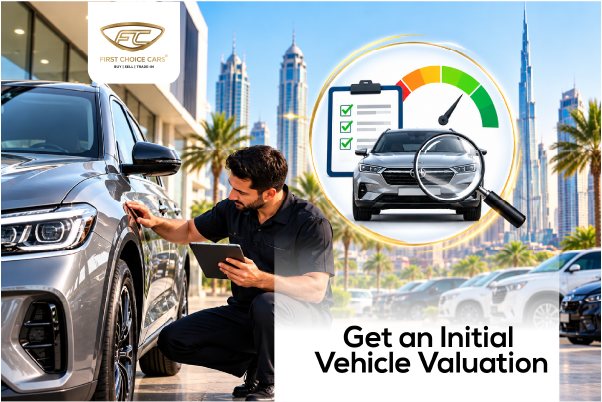
The process usually begins with the vehicle details.
First Choice Cars' current trade-in form asks for information including:
- Make
- Model
- Trim
- Year
- Kilometers
- Specification
- Expected price
- Vehicle condition
- Service history
The vehicle you are interested in purchasing
This information gives the dealer a starting point.
But it is important not to confuse the initial valuation with the final trade-in offer.
First Choice Cars explains that its online valuations are based on the information supplied and that a physical inspection is required before a purchase offer is made.
Step 2: Physical Vehicle Inspection
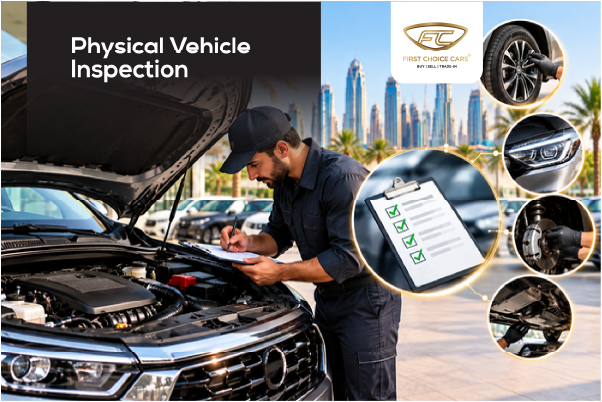
The inspection is where the initial estimate is tested against the actual vehicle.
The dealer can examine the condition and compare it with the information submitted.
Relevant factors can include:
- Exterior condition
- Interior condition
- Mechanical condition
- Mileage
- Accident history
- Service history
- Specification
- Modifications
- Tyres
- Documentation
- Current market demand
First Choice Cars' terms state that its acceptance of a used vehicle as part of the exchange is subject to valuation, on-site inspection and examination, documentation, and confirmation of the purchase price.
This is why honesty during the initial valuation is important.
If the vehicle's actual condition differs substantially from what was submitted, the final value can also differ.
Step 3: Receive the Final Trade-In Offer
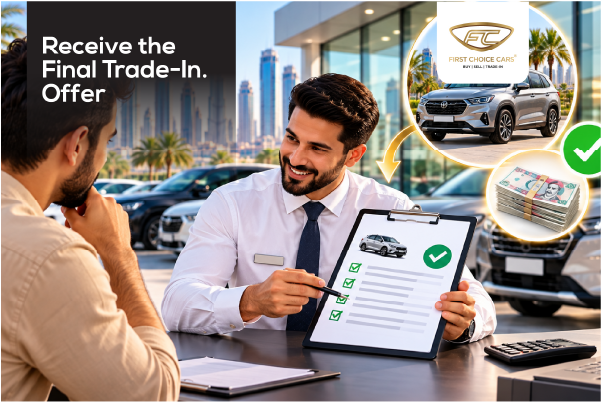
After the physical assessment, the dealer can provide the final offer.
At this point, you have a clearer understanding of what the current vehicle is worth within the transaction.
First Choice Cars states that its trade-in offer is subject to the vehicle's inspection and the completion of the necessary requirements.
They also state that trade-in valuations are normally valid for 72 hours, provided there is no material change in the vehicle's condition, mileage, documents, or market circumstances.
That means sellers should not assume that an offer will remain unchanged indefinitely.
Step 4: Choose the Replacement Vehicle
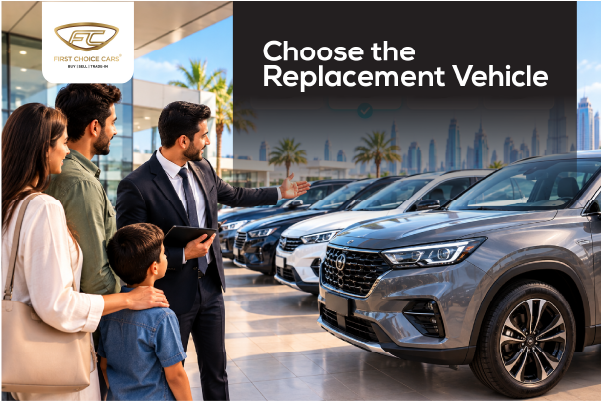
Once you understand the trade-in value, you can focus on the vehicle you want to purchase.
This is where the process can become considerably simpler.
Instead of completing one sale and then beginning a separate purchase, you can potentially connect them.
First Choice Cars offers a range of used cars and commercial vehicles through its inventory.
When choosing the replacement vehicle, however, do not focus exclusively on the trade-in figure.
Consider the complete transaction.
A slightly different trade-in value may not matter as much as the total price and condition of the replacement vehicle.
Step 5: Apply the Trade-In Value Toward the Next Car
After the vehicle has been inspected, the offer accepted, and the required documentation or finance settlement completed, the agreed trade-in value can be applied toward an eligible vehicle from the dealer's inventory.
First Choice Cars explicitly describes this process on its current trade-in page. For the customer, the main benefit is convenience.
You do not necessarily need to sell your old car first and then return to the market with cash in hand.
Instead, the value of the existing vehicle becomes part of the replacement transaction.
How Existing Car Finance Is Handled
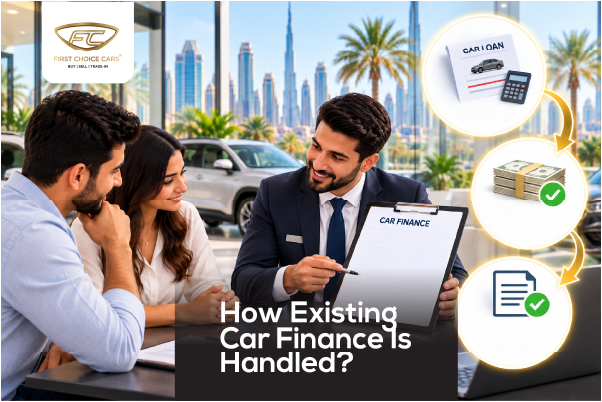
This is one of the most important questions for anyone with an outstanding vehicle loan.
The UAE government explains that car loans are secured by a mortgage over the financed vehicle in favor of the bank or finance company that provided the loan.
That means an outstanding loan needs to be addressed before the vehicle can be transferred appropriately.
First Choice Cars currently states that customers with outstanding finance can provide a current settlement letter from their bank or finance company. The settlement amount is deducted from the agreed trade-in value, with the company assisting with the settlement paperwork.
This creates an important distinction between:
Trade-in value
and
Equity remaining after finance settlement.
For example, if the agreed trade-in value is AED 70,000 but the outstanding settlement figure is AED 50,000, the two figures should not be treated as though they are both available toward your next vehicle.
The finance settlement has to be accounted for first.
The exact financial result depends on the actual valuation and settlement amount.
What Affects Your Trade-In Value?
A trade-in valuation is not based on one factor.
Several elements can work together.
Mileage
Mileage indicates how extensively the vehicle has been used.
But it should be considered together with condition and maintenance.
Condition
A well-maintained vehicle in good overall condition can be easier to prepare for resale than one requiring significant work.
Accident History
Previous accident damage can influence the vehicle's resale position.
Abu Dhabi Police provides an official Vehicle Accidents Inquiry service that allows accident information to be searched using the chassis number.
Service History
Documented maintenance provides useful evidence about how the vehicle has been cared for.
Specification
The vehicle's specification can influence its market suitability.
Dubai RTA's official ownership-transfer service also includes requirements relating to vehicle documentation and, where relevant, Gulf-specification compliance.
Current Market Demand
A dealer also needs to consider whether the vehicle is currently attractive to buyers.
First Choice Cars states that its purchase and trade-in assessments consider current market circumstances and demand.
The Main Benefits of Trading in a Car
- Convenience: This is perhaps the most obvious benefit. You can connect the sale of your current car with the purchase of another.
- Less Private Advertising: You do not need to create a private listing and manage every inquiry yourself.
- Fewer Time-Wasters: Private listings can generate inquiries from people who are not ready to purchase. A dealer-managed transaction can reduce that part of the process.
- Easier Upgrade: If you already know what you want to buy next, trade-in can create a smoother transition.
- Finance Support: For financed vehicles, First Choice Cars states that its process can include support with the bank settlement paperwork.
- Streamlined Paperwork: First Choice Cars also describes its trade-in service as reducing the administrative burden associated with the transaction.
Trade-In vs. Private Sale: Advantages and Disadvantages
There is no universal winner.
The better option depends on what you value.
| Factor | Trade-In | Private Sale |
|---|---|---|
| Convenience | Generally higher | Requires more seller involvement |
| Advertising | Dealer-managed | Seller manages advertising |
| Buyer enquiries | Dealer handles process | Seller handles enquiries |
| Negotiation | Dealer offer | Direct negotiation |
| Time commitment | Usually lower | Potentially higher |
| Replacement car | Can be part of same transaction | Separate purchase |
| Finance | Can be handled as part of the process | Seller manages settlement |
| Control | Less direct control over resale process | More direct control |
This table is a practical comparison rather than a guarantee that every individual transaction will follow exactly the same path.
When Trading In Makes the Most Sense
Trade-in can be particularly useful when convenience is your priority.
- You may find it suitable if:
- You already know you want another car.
- You do not want to advertise your current vehicle.
- You do not want to deal with multiple private buyers.
- You want to minimize the time between selling and replacing the vehicle.
- Your existing vehicle is financed.
- You prefer a dealer-managed transaction.
- You want the value of your current car applied directly toward another vehicle.
First Choice Cars currently allows customers to select a replacement vehicle as part of its trade-in enquiry process.
When Selling Privately Might Make More Sense

Private selling can be worth considering when you have the time and willingness to manage the process yourself.
It may suit you if:
- You are not in a hurry.
- You are comfortable advertising the vehicle.
- You want direct contact with buyers.
- You are willing to arrange viewings.
- You are comfortable negotiating.
- You want to explore private-market demand.
However, remember that advertised prices are not the same as completed sale prices.
A car listed online for AED 100,000 does not prove that it actually sold for AED 100,000.
This is important when comparing private advertisements with a dealer's trade-in offer.
What Documents Are Normally Required?
The exact requirements can depend on the vehicle and transaction.
First Choice Cars currently lists the following for trade-in:
- Emirates ID
- Driving license
- Vehicle registration card (Mulkiya)
- Available service history
- Car keys
Additional documentation may be required for company-owned, third-party, or financed vehicles.
For financed vehicles, the current settlement letter from the bank or finance company is particularly important.
How UAE Vehicle Ownership Transfer Fits Into the Process
Trade-in and ownership transfer are connected but different stages.
The trade-in is the commercial arrangement between you and the dealer.
Ownership transfer is the official registration process.
Dubai RTA's current service allows vehicle ownership to be transferred from the seller and officially registered under the buyer's name. The service includes an online sale and purchase agreement and provides the relevant ownership certificate.
The official requirements can vary according to the circumstances. That is why sellers should rely on the relevant authority's current requirements rather than an old checklist found online.
How to Prepare Your Car Before Getting a Trade-In Valuation

Preparation does not mean hiding flaws.
It means making sure the vehicle is presented accurately and that the relevant information is available.
- Clean the Vehicle: A clean car is easier to inspect.
- Gather Service Records: Keep invoices and service records together.
- Bring the Keys: If you have both sets, bring them.
- Organize the Mulkiya: Keep your registration documents accessible.
- Prepare Identification: Have the relevant identification documents ready.
- Be Honest About Repairs: Do not attempt to hide accident damage or known mechanical problems.
- Get the Finance Settlement Figure: If the vehicle is financed, request a current settlement statement from the lender.
- Remove Personal Belongings: Before handing the vehicle over, remove valuables and personal items.
Common Mistakes That Can Reduce Trade-In Value
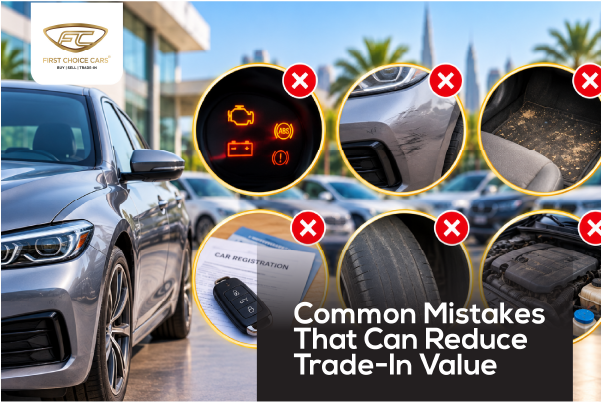
Some valuation problems are avoidable.
Providing Incorrect Mileage
If the mileage submitted online is wrong, the initial estimate may not reflect the actual vehicle.
Hiding Accident Repairs
An inspection can reveal previous repairs, so transparency is better than allowing the discovery to become a surprise.
Losing Service Records
Missing records make the vehicle's maintenance history harder to establish.
Assuming Modifications Add Their Full Cost
The amount spent on an accessory is not automatically equal to the amount it adds to resale value.
Comparing With Advertised Prices
A seller's asking price is not proof of the actual transaction value.
Ignoring Outstanding Finance
Your remaining loan balance must be considered when calculating the actual financial outcome.
How First Choice Cars' Trade-In Process Works
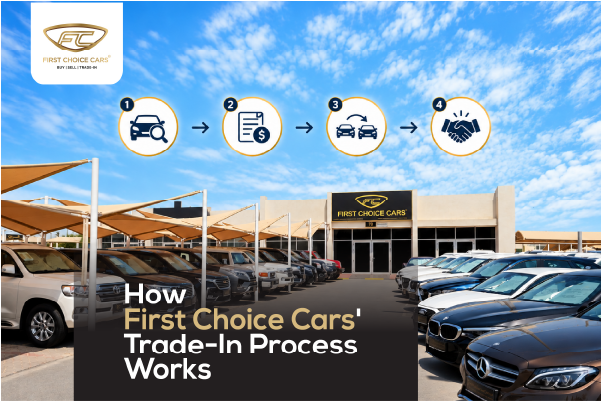
First Choice Cars currently presents its trade-in process in four basic steps:
Get a quote → Schedule an inspection → Receive an offer → Complete the trade-in.
The company states that inspections can be arranged at its showroom or at the customer's home across the UAE, subject to location and scheduling.
The final offer is based on the vehicle's assessment rather than the initial online estimate alone.
First Choice Cars' terms also state that the company is not bound to accept the vehicle at a particular part-exchange price until the valuation, on-site inspection, examination, documentation, and purchase-price confirmation have been completed.
This makes the physical inspection a central part of the process.
What If Your Car Is Not in Perfect Condition?
A common misconception is that a trade-in is only suitable for cars in excellent condition.
That is not necessarily the case.
First Choice Cars currently states that customers can submit a vehicle that is not in perfect condition for assessment. The required repairs and mechanical, cosmetic, and structural condition can affect the valuation, with final acceptance and value confirmed after inspection.
This can be useful for owners who do not want to spend significant money repairing a vehicle before selling it.
However, you should still consider the economics.
If a repair is inexpensive and materially improves the vehicle's condition, completing it may be sensible.
If a repair is expensive and the expected increase in trade-in value is small, spending the money first may not make financial sense.
The best decision depends on the individual vehicle.
Should You Repair Your Car Before Trading It In?

There is no universal answer.
Consider three questions.
Is the Repair Necessary?
If the car has a serious mechanical or safety issue, it may be worth addressing before the transaction.
How Much Will It Cost?
Get a realistic repair estimate.
Will It Meaningfully Improve the Outcome?
Do not assume that spending AED 5,000 automatically adds AED 5,000 to the trade-in value.
A dealer is assessing the vehicle as a whole.
Some repairs may make the car easier to sell but do not necessarily produce a matching increase in valuation.
Looking at the Whole Deal
One of the biggest mistakes people make with trade-in is focusing only on the value assigned to the old vehicle.
Suppose Dealer A offers AED 60,000 for your current car and sells the replacement vehicle for AED 120,000.
Dealer B offers AED 65,000 for your current car but sells a comparable replacement vehicle for AED 130,000.
At first glance, Dealer B's trade-in offer looks better.
But the difference disappears when you look at the complete transaction.
That is why the most useful comparison is
Replacement vehicle price − trade-in value + any finance/fees/other applicable costs
The exact calculation depends on the transaction.
The principle is simple:
Compare the complete deal, not one number.
Is Trade-In Right for You?
Ask yourself what you want from the process.
If your priority is convenience, trade-in can be attractive.
If you are buying another vehicle from the same dealer, the process can be especially straightforward.
If you are prepared to spend time finding a private buyer and believe the additional effort is worthwhile, selling privately may be preferable.
There is no universally correct answer.
The right option depends on your vehicle, your replacement car, your financial position, and how much time you want to spend managing the sale.
Final Thoughts
Trading in a car in the UAE does not have to be complicated.
The basic journey is straightforward:
Initial valuation → physical inspection → final offer → replacement vehicle → trade-in value applied → ownership and finance formalities completed.
The exact details depend on the vehicle, its condition, documents, financial position, and the transaction itself.
The biggest advantage of trade-in is convenience.
Instead of selling your current car separately and then finding your next one, you can potentially combine the two processes.
But convenience should not mean skipping due diligence.
Understand the valuation, ask how outstanding finance will be handled, keep your documents ready, and compare the complete cost of your next vehicle.
If you are ready to explore your options, you can request a First Choice Cars trade-in valuation and have your vehicle assessed.
Frequently Asked Questions
How does car trade-in work in the UAE?
You provide information about your existing vehicle, receive an initial valuation, arrange a physical inspection, and receive a final offer based on the vehicle's actual condition and relevant market factors. If you accept the offer and complete the required documentation, the agreed trade-in value can be applied toward an eligible replacement vehicle.
Can I trade in a car that still has outstanding finance?
Yes, subject to the vehicle's eligibility and lender settlement requirements. First Choice Cars states that customers can provide a current settlement letter from their bank or finance company, with the outstanding amount deducted from the agreed trade-in value and the relevant settlement paperwork handled as part of the process. The UAE government also explains that car loans are secured by a mortgage over the financed vehicle.
Is trade-in better than selling a car privately?
It depends on your priorities. Trade-in can offer convenience, reduce the need for private advertising, and connect the sale of your existing vehicle with the purchase of another. A private sale may give you more direct control over advertising and negotiation, but it generally requires more involvement from the seller.
What documents do I need to trade in my car?
First Choice Cars currently lists an Emirates ID, driving license, vehicle registration card (Mulkiya), available service history, and car keys among the documents/items required for a trade-in. Additional documents may be required for financed, company-owned, or third-party vehicles.
Disclaimer: This article is general information, not legal, tax or financial advice. Bank procedures, settlement charges, release timings and registration requirements are set by the banks and the relevant authorities and change from time to time. Confirm the current position with your own lender and registering authority before acting. Payment timings described here apply to eligible vehicles and are subject to our published terms. While First Choice Cars makes every effort to ensure the accuracy of the information provided, we hold no responsibility for any errors, omissions, or outdated content.